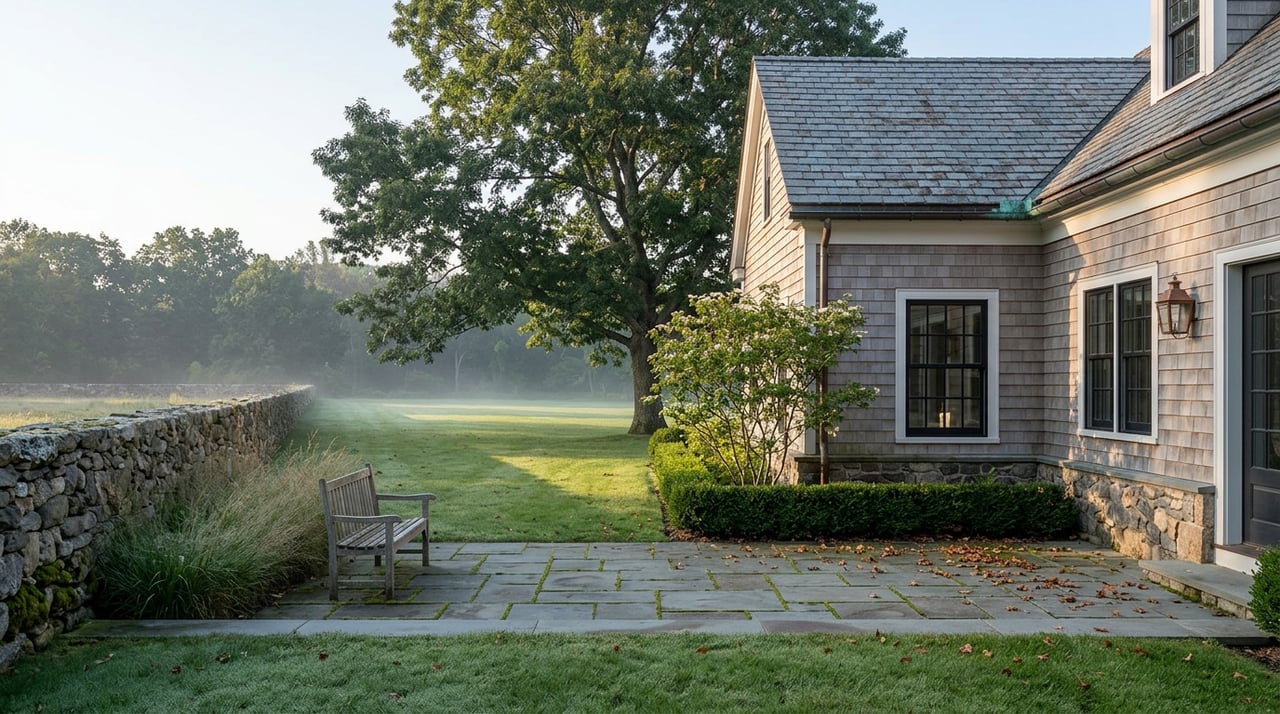
Dowse Orchards Sherborn Cider Apples You Never Notice
September 3, 2026
September 3, 2026
Walk past the parking area at Dowse Orchards, past the rows where families fill mesh bags with McIntosh and Cortland every weekend in September, and the trees start to look wrong. The apples hang smaller, some blushed red and rough-skinned, some nearly green and lumpy. These aren't pick-your-own apples; they're grown for cider.
That block belongs to Stormalong Cider, and it is the reason Sherborn is quietly becoming cider country again for the first time in about a century. Not because a brewery moved to town and needed a marketing angle. Because the specific apples growing on that leased ground, apples most people would spit out if they bit into one, are the same category of fruit that once made this town famous enough to have its own railroad spur built for it.
Dowse Orchards has been a Sherborn fixture long enough that most residents stopped thinking of it as remarkable. It is a Massachusetts Century Farm with roughly 200 years of continuous family production on North Main Street, and its farm stand has been selling roadside since well before most current residents were born. More than 20 apple varieties grow across its acreage, with McIntosh, Cortland, and Macoun as the reliable favorites, alongside maple syrup, preserves, and cider pressed fresh on-site every week. This is the version of Dowse everyone in town has visited: a place for filling a bushel bag, not for asking questions about what else might be growing there.
The other block is easy to miss unless you know to look for it. More than a decade ago, a cidermaker named Shannon Edgar, a former music industry executive from Holliston who had relocated back to Massachusetts, started leasing additional acreage at Dowse specifically to plant apples nobody wants to eat fresh. These are cider apples, a different category of fruit entirely: bittersweet and tannic varieties bred over centuries in England and colonial New England for pressing, not biting.
The list reads like an heirloom seed catalog rather than a produce aisle. Dabinett. Black Oxford. Golden Russet. Esopus Spitzenburg. Calville Blanc d'Hiver. Chisel Jersey. Reine de Pomme. Wickson. Some of these cultivars trace back to the 1600s, grown in New England small orchards long before anyone was optimizing fruit for a lunchbox.
Here is the difference in practical terms:
| At the farm stand | On the leased block |
|---|---|
| McIntosh, Cortland, Macoun | Dabinett, Black Oxford, Esopus Spitzenburg |
| Sweet and crisp enough to eat off the tree | Tannic, bitter, meant for the press |
| Picked by hand each fall for eating, pie, and sauce | Picked for fermentation, not the fruit bowl |
| On these acres for generations | Planted under lease within the last decade or so |
Stormalong uses fruit like this in its Rare Apple Series, including a single-varietal Kingston Black cider and a Boston Heirloom blend of Roxbury Russet and Baldwin, two of the oldest apple varietals grown in the United States. The company's founder has described the appeal in plain terms: he was fascinated that the apples from the 1600s are still kicking around, still growable, still capable of producing something close to what a colonial-era cidermaker would have tasted.
The reason any of this matters to Sherborn specifically, rather than being a story that could happen in any apple-growing town, goes back to the late 1800s. According to Stormalong's own account of the town's history, Sherborn was home to what was billed as the largest refined cider mill in the world, operating from roughly 1880 to 1930 and exporting what the company describes as "champagne cider" to markets in England and beyond. The mill's owner, Jonathan Holbrook, had enough leverage to convince the Framingham and Mansfield Railroad to route its tracks through Sherborn specifically to serve his operation. The first freight train into town carried apples bound for his press.
At that point, the town supported something like 40 working orchards. Today, Sherborn has essentially two working farms that the public can visit for fruit: Dowse Orchards and Sunshine Farm, the Geoghegan family's 100-acre operation on Kendall Avenue that runs pick-your-own strawberries, blueberries, peaches, and apples from spring through fall. These figures describe different things, but together they offer a glimpse of the changing scale and visibility of agriculture in town.
Stormalong's presence at Dowse is not incidental to that history. It is a direct attempt to graft a nearly vanished industry back onto the one piece of orchard ground still willing to lease acreage for it.
The scaling story matters too, because it shows this was never just a hobby project. Stormalong's original production ran out of a converted horse barn on a home farm on Sewall Brook Lane in Sherborn. By 2017, growth pushed core production to a new facility in Leominster, built inside the New England Apple Products building, next to a rack and cloth apple press capable of squeezing roughly 20,000 gallons of cider a day, so juice no longer has to be trucked in by tanker. The specialty ciders, the barrel-aged blends, and anything requiring six months or more of fermentation and aging still get made back on the original Sherborn property.
Distribution has grown outward from there too. What started as a handful of Massachusetts wine shops now includes distribution partnerships that carry Stormalong into Rhode Island and Vermont, on top of continued sales throughout Massachusetts. None of that changes where the rare apple varieties are actually grown. The Dowse block remains part of the operation, tying the company's furthest-reaching bottles back to a specific few acres on North Main Street.
For a resident who wants to taste the result without leaving town, Heritage of Sherborn is the direct line. The restaurant operates out of the former 18th century Sherborn Inn, run by Josh and Jen Ziskin, and it has poured Stormalong cider since the cidery's early years. The current dinner menu still lists a dish built around a Stormalong cider batter, and the attached retail shop, Heritage Fine Wine, Coffee and Provisions, stocks Stormalong bottles and cans alongside other local beer and cider.
That is the short version of the loop: apples grown on leased rows behind a familiar orchard, pressed and fermented a few miles away or up in Leominster, and served back at a restaurant inside a building that predates the cider mill that made Sherborn notable in the first place.
None of this changes what happens at Dowse's pick-your-own rows this fall. The McIntosh will still be sweet, the Cortland will still hold up in a pie, and the lines at the farm stand will still form the way they always have. What changes is what you notice past the parking area, on the block where cider apples grow outside the pick-your-own rows.
Sherborn spent close to a century as a town most people associated with hay fields and conservation land rather than agriculture with any commercial identity. The reappearance of cider-specific apples on a leased corner of a 200-year-old farm is a small, specific counterpoint to that. It does not recreate the old cider industry or its dedicated rail spur. It is one block of odd-looking fruit, grown on purpose, turning into something a neighbor can order at dinner in the middle of town.
That is usually how these things work in towns like this one. Not a headline. A quiet correction to what you assumed you already knew about a place you drive past every week.
Beyond Boston Properties spends its time in towns like Sherborn precisely because the details that make a place worth living in rarely show up on a listing sheet. If you are curious what a specific Sherborn property is actually worth in today's market, or you are weighing a move to a town like this one, request a personalized home valuation and let's talk through what we know about the ground here, not just the comps.
Stay up to date on the latest real estate trends.
Contact us today to discover how the power of three can elevate your home buying and selling experience in the towns and communities of Greater Boston.